


Anime Genres Explained: A Beginner's Guide to the Main Types
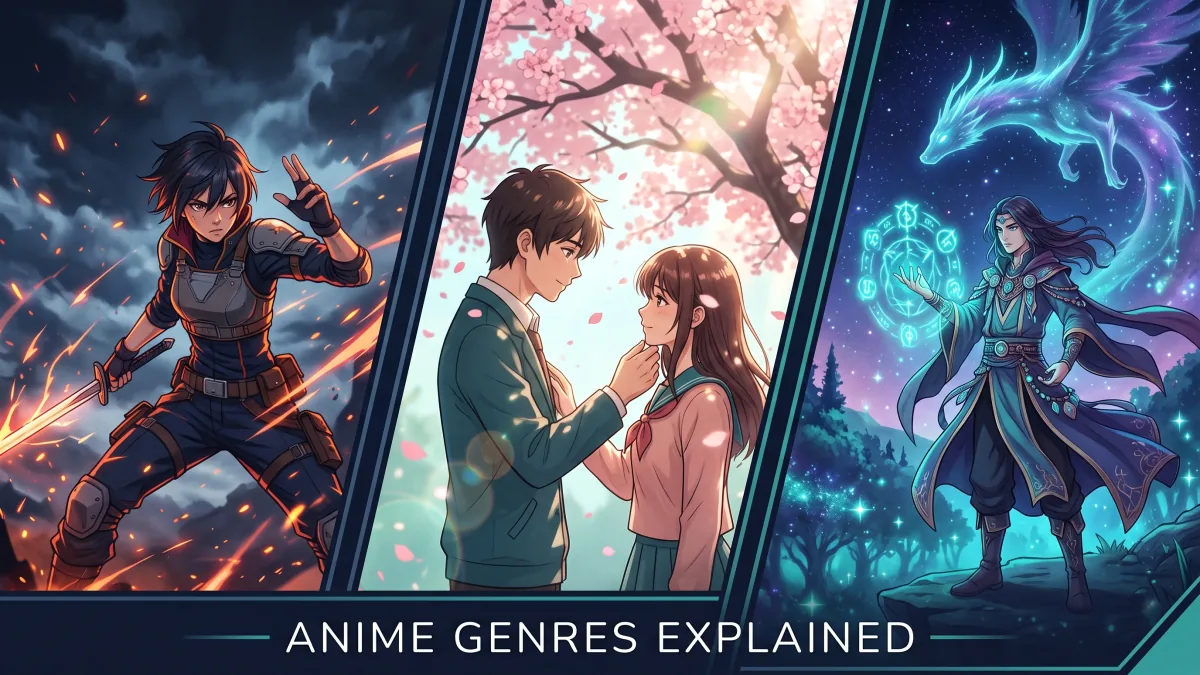
Anime genres are labels that help viewers understand the audience, themes, and storytelling style of an animated series or film. These labels often overlap, so they are useful starting points — not strict rules.
On this page24
- What do anime genre and anime actually mean?
- What are the four main anime demographic categories?
- What is shonen anime?
- What is shojo anime?
- What are seinen and josei?
- What are the most popular story genres in anime?
- What is isekai anime?
- What is mecha anime?
- What does slice of life mean?
- How do anime genres mix together?
- What are common misunderstandings about anime genres?
- How can you choose your first anime genre in five steps?
- Which anime genre fits your preferences?
- How can you find anime in your favorite genre legally?
- Quick recap: what should beginners remember?
- Frequently Asked Questions
- Is anime a genre or a style of animation?
- What is the difference between shonen and shojo?
- Is shonen only for boys?
- What is shojo anime usually about?
- What is isekai in simple terms?
- What makes mecha different from other science fiction?
- Does slice of life mean nothing happens?
- How do I know if an anime is suitable for children?
What do anime genre and anime actually mean?
An anime genre is a category used to describe the kind of story, mood, setting, or audience an animated work is aimed at. Anime is the commonly used term for Japanese animation and, in everyday international conversation, its distinctive range of animated storytelling. A genre is a label for a recognizable type of story, such as fantasy, mystery, or romance. Genre labels help you discover what you might enjoy, but they cannot tell you everything about a title.
You may also see the word manga, which means Japanese comics and graphic storytelling. An animated adaptation and its manga source can share a premise while using different pacing, scenes, or story details.
What are the four main anime demographic categories?
The four commonly discussed demographic categories are shonen, shojo, seinen, and josei. They originated as publishing and marketing labels for intended audiences, especially in manga; they do not determine who is allowed to enjoy a story or guarantee a particular tone.
A demographic is a group defined for audience or marketing purposes. In anime discussions, demographic labels are often borrowed from the manga publishing context, so they are best understood as clues about a work's original target readership rather than universal descriptions of its content.
| Category | Traditional target audience | Typical themes | Typical tone |
|---|---|---|---|
| Shonen | Teen boys, traditionally | Growth, friendship, challenges, teamwork, competition, adventure | Often energetic and action-oriented, but can vary widely |
| Shojo | Teen girls, traditionally | Relationships, emotional growth, identity, friendship, romance | Often character-focused and emotionally expressive, but not always romantic |
| Seinen | Adult men, traditionally | Complex choices, work, society, psychological conflict, varied action or drama | Can be reflective, nuanced, dark, funny, or understated |
| Josei | Adult women, traditionally | Adult relationships, daily responsibilities, personal change, work and family life | Often realistic or nuanced, with a wide range of moods |
What is shonen anime?
Shonen refers to works traditionally marketed to teenage boys. Common themes include learning through challenges, building friendships, practising a skill, and working toward a difficult goal. Action and competition are frequent, but the label does not mean that every story has constant fighting or that only boys will like it.
What is shojo anime?
Shojo describes works traditionally marketed to teenage girls. Stories may emphasize relationships, identity, friendship, self-confidence, emotional change, or romance. However, romance is not a requirement, and shojo is not one visual style or one kind of plot.
What are seinen and josei?
Seinen is traditionally marketed to adult men, while josei is traditionally marketed to adult women. Both can explore grown-up responsibilities, complicated relationships, social expectations, identity, and consequences that unfold over time. Their stories are not automatically mature, serious, or realistic; tone varies from title to title.
What are the most popular story genres in anime?
Story genres describe the subject, setting, or experience a viewer can expect. Unlike demographic categories, they can apply across different audiences, and one story can combine several at once.
| Genre | What it means | What to expect |
|---|---|---|
| Action and adventure | Stories built around movement, challenges, journeys, or confrontation | Fast pacing, obstacles, discovery, and changing goals |
| Fantasy | A world with magic, imagined rules, or other-than-everyday elements | World-building, quests, unusual abilities, and invented settings |
| Science fiction | Stories shaped by imagined technology, scientific ideas, or possible futures | Speculation, futuristic settings, ethical questions, and discovery |
| Romance | Stories focused on attraction, connection, or changing relationships | Emotional tension, communication, misunderstandings, and growth |
| Comedy | Stories designed primarily to amuse | Wordplay, timing, exaggerated reactions, recurring jokes, or satire |
| Mystery and suspense | Stories that invite the audience to solve a question or anticipate a threat | Clues, uncertainty, investigation, and gradual reveals |
| Sports | Stories centered on a sport, a team, or athletic goals | Practice, tactics, rivalries, teamwork, and persistence |
| Slice of life | Stories about ordinary routines and everyday experiences | Small moments, relationships, personal reflection, and a relaxed pace |
| Horror | Stories built to create unease, fear, or tension | Atmosphere, uncertainty, frightening situations, and suspense |
| Isekai | A story in which a character travels to, is reborn in, or becomes trapped in another world | Discovery, unfamiliar rules, adaptation, and a new identity or challenge |
| Mecha | Stories in which large mechanical machines, often piloted, are central | Mechanical design, pilots, conflict, technology, and the people affected by it |
| Psychological drama | Stories focused on thoughts, motives, decisions, and emotional pressure | Character analysis, difficult choices, unreliable assumptions, and inner conflict |
| Music and performance | Stories centered on singing, instruments, dance, or performance goals | Rehearsal, creativity, teamwork, stage pressure, and artistic growth |
What is isekai anime?
Isekai is a Japanese term meaning another world. In anime, it generally describes a story where a character enters, is reborn in, or becomes stranded in a world different from their original one. The new setting might operate through fantasy rules, unfamiliar societies, or imagined systems that the character must learn to navigate.
Isekai is a premise rather than a promise about tone. One story may focus on exploration and problem-solving, while another emphasizes comedy, teamwork, or personal growth.
What is mecha anime?
Mecha refers to stories in which mechanical machines — often large robots controlled by people — play a central role. The machines may be used for exploration, rescue, competition, defence, or conflict. Mecha is not automatically an action-only category; it can also be science fiction, a character drama, a mystery, or a coming-of-age story.
What does slice of life mean?
Slice of life describes stories built around ordinary experiences rather than a single extraordinary mission or major threat. The plot may follow friendships, school or work routines, hobbies, family life, or small personal changes. The pace can be calm, funny, sentimental, or thoughtful, and it can overlap with romance, comedy, sports, or a workplace story.
How do anime genres mix together?
Most anime stories combine more than one genre because a story can have a setting, a mood, a central conflict, and a character focus at the same time. A single work could be fantasy and adventure, science fiction and mystery, or slice of life and comedy. Its demographic category may sit alongside all of those story labels.
Think of a genre as a lens, not a locked box. Fantasy tells you something about the world, mystery tells you how information is revealed, and comedy tells you about the intended effect of many scenes. They can all describe the same story without contradicting each other.
What are common misunderstandings about anime genres?
The most common mistake is treating a genre or demographic label as a strict rule. Labels are shorthand; they are not a full description of a work, a guarantee about its content, or a barrier that decides who should watch it.
How can you choose your first anime genre in five steps?
- Choose a mood. Decide whether you want something funny, moving, exciting, mysterious, calming, or imaginative.
- Choose a story engine. Do you prefer solving a puzzle, following a journey, building a relationship, improving a skill, or exploring a new world?
- Pick one or two genres. Start with a broad combination, such as comedy and slice of life, or fantasy and adventure.
- Read the synopsis and age guidance. Check the official description and rating instead of relying on a genre label alone, especially when choosing for a younger viewer.
- Try a small sample and reassess. Watch an opening episode or another short, official sample where available. If the pacing or subject is not for you, switch genres without feeling that you have failed.
Which anime genre fits your preferences?
| If you like… | Try these genres | Why they may fit |
|---|---|---|
| Puzzles and uncovering clues | Mystery, suspense, psychological drama | They reward attention and gradual discovery |
| Imagined worlds and unusual rules | Fantasy, science fiction, isekai | They invite exploration of different settings and possibilities |
| Personal connections and emotional change | Shojo, josei, romance, slice of life | They often give relationships and inner growth room to develop |
| Goals, teams, and steady improvement | Sports, shonen, adventure | They often focus on practice, setbacks, collaboration, and progress |
| Machines and technical ideas | Mecha, science fiction | They place technology, design, and human choices near the centre |
| Light, everyday entertainment | Comedy, slice of life | They can focus on humour, routines, and familiar situations |
| Suspense and an eerie atmosphere | Mystery, suspense, horror | They use uncertainty and tension to keep the audience engaged |
How can you find anime in your favorite genre legally?
Use official, licensed viewing options and the genre descriptions they publish. Search within a service's categories, read its synopsis, and consult its age rating or content information before starting a title. If you are choosing for a family or younger viewer, check both the age guidance and the description. A demographic category such as shonen or josei is not a substitute for a content rating.
Quick recap: what should beginners remember?
Frequently Asked Questions
Is anime a genre or a style of animation?
Anime is a term commonly used for Japanese animation, not a single story genre. Anime can include comedy, fantasy, mystery, romance, science fiction, slice of life, and many other types of storytelling.
What is the difference between shonen and shojo?
Shonen and shojo are traditional demographic labels associated with works marketed to teenage boys and teenage girls, respectively. They do not define who can enjoy a story, and neither label guarantees a specific plot or tone.
Is shonen only for boys?
No. The label describes a traditional target audience, not a rule about who should watch. Viewers of any gender can enjoy shonen stories for their action, humour, friendships, characters, or other themes.
What is shojo anime usually about?
Shojo often focuses on relationships, identity, emotional growth, friendship, or romance. These are common tendencies rather than requirements, so the synopsis is a better guide to an individual story.
What is isekai in simple terms?
Isekai means another world. It generally describes a story in which a character enters, is reborn in, or becomes trapped in a world different from their original one.
What makes mecha different from other science fiction?
Mecha places mechanical machines, often large piloted robots, at the centre of the story. It can overlap with science fiction, action, drama, mystery, and other genres, so the main difference is the importance of the machines to the premise.
Does slice of life mean nothing happens?
No. Slice of life usually focuses on everyday routines and personal moments rather than one huge central mission. Character growth, friendship, humour, and meaningful small changes can still provide a strong story.
How do I know if an anime is suitable for children?
Check the official age rating and content information for the specific title, and consider the child's age and sensitivities. A demographic label such as shonen or shojo does not replace an age rating.