




Offside Rule in Football Explained Simply
The offside rule stops attackers from gaining an unfair advantage by waiting too close to the opponent's goal. A player is not penalised just for standing in an offside position — they must also become involved in active play.
On this page22
- What is the offside rule in football?
- When is a player in an offside position?
- Offside vs onside at a glance
- When does an offside position become an offence?
- 1. Interfering with play
- 2. Interfering with an opponent
- 3. Gaining an advantage
- When can a player not be offside?
- Six simple offside rule examples
- How to spot offside in 3 seconds
- How do VAR and assistant referees judge offside?
- Common misunderstandings
- Quick recap
- Frequently Asked Questions
- What is offside in soccer in simple terms?
- Can you be offside in your own half?
- Can a player be offside if they do not touch the ball?
- Is a player offside if they are level with the last defender?
- Why is there no offside from a throw-in, corner, or goal kick?
- Does a deflection by a defender reset offside?
- How does VAR check offside?
- What is the punishment for offside?
What is the offside rule in football?
The offside rule limits an attacker's position when a teammate plays the ball. It prevents a forward from gaining an unfair advantage by waiting close to the opposing goal, but it does not mean attackers must always stay behind defenders.
Under Law 11 of the Laws of the Game, position and involvement both matter. Standing in an offside position is not automatically an offence; the player must become involved in active play. The rule is published by the International Football Association Board (IFAB).
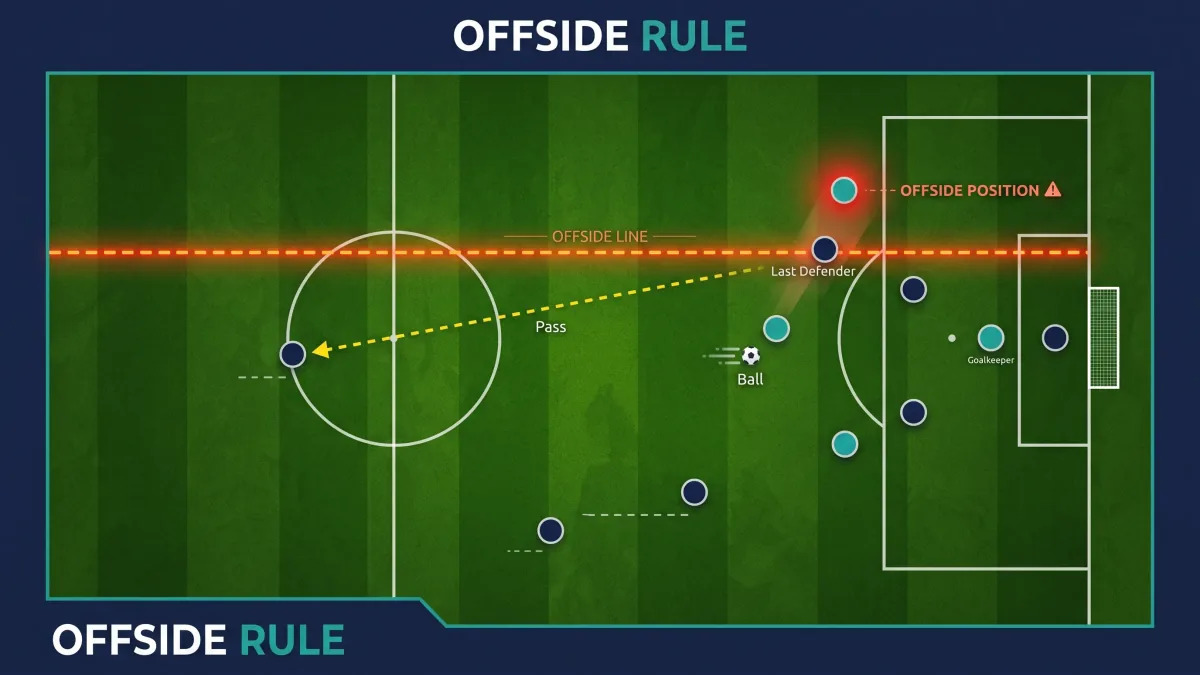
To judge a pass, look at the exact moment the teammate plays or touches the ball. Compare the attacker with the halfway line, the ball, and the second-last opponent, then check whether the attacker affects the play.
When is a player in an offside position?
A player is in an offside position when any eligible part of the head, body, or feet is in the opponents' half (not on the halfway line) and nearer the opponents' goal line than both the ball and the second-last opponent. Hands and arms — including a goalkeeper's — do not count.
Use three checks:
- Halfway line: The attacker must be in the opponents' half.
- Body parts: Head, body, and feet count; hands and arms do not. The arm's upper boundary aligns with the bottom of the armpit under the Laws of the Game.
- Reference points: The attacker must be nearer the goal line than both the ball and the second-last opponent. The goalkeeper is often one of those opponents, but not always.
If the attacker is level with the second-last opponent or level with the ball, they are not in an offside position. Judge the position when the teammate plays the ball, not when it arrives.
Offside vs onside at a glance
| Situation | Position decision | Why |
|---|---|---|
| Attacker is level with the second-last opponent | Onside | Level is not offside. |
| Attacker is behind the ball | Onside | The attacker is not nearer to the goal line than the ball. |
| Attacker is in their own half | Onside | An attacker must be in the opponents' half to be in an offside position. |
| Attacker's head or foot is nearer the goal line than both the ball and second-last opponent | Offside position | An eligible body part is beyond both reference points. |
| Only the attacker's hand or arm is beyond the defender | Not offside on that basis | Hands and arms are not counted. |
| Attacker is in an offside position but makes no active-play involvement | No offence yet | Position alone is not penalised. |
When does an offside position become an offence?
An offside offence happens only when a player who was in an offside position when a teammate played or touched the ball becomes involved in active play. Law 11 groups this involvement into three categories.
1. Interfering with play
This means playing or touching the ball passed or touched by a teammate. For example, an attacker starts in an offside position, runs onto a through-ball, and touches it. If no exception applies, the attacker has committed an offside offence.
2. Interfering with an opponent
A player can be penalised without touching the ball if their actions affect an opponent — for example, by clearly blocking an opponent's line of vision, challenging them for the ball, clearly attempting to play a nearby ball in a way that impacts them, or making an obvious action that clearly affects their ability to play it. Simply standing in an offside position near the goal is not automatically enough.
3. Gaining an advantage
A player may gain an advantage by playing the ball or interfering with an opponent after the ball rebounds or is deflected from the goalpost, crossbar, match official, or an opponent, or after an opponent makes a deliberate save. A rebound off the goalkeeper after a save can therefore matter if the attacker was offside when a teammate originally played the ball.
When can a player not be offside?
A player cannot be penalised for receiving the ball directly from a goal kick, throw-in, or corner kick. A defender's deliberate play may also reset the situation, but a deliberate save is treated differently.
| Situation | Offside from the direct delivery? | Why |
|---|---|---|
| Goal kick | No | A player may receive it directly, even beyond the defensive line. |
| Throw-in | No | Law 11 excludes direct receipts from throw-ins. |
| Corner kick | No | Direct receipts from corners are exempt. |
| Ordinary pass from a teammate | Potentially | The normal position and active-play tests apply. |
| Opponent's deliberate play | Usually not for the previous position | A deliberate attempt to play the ball can reset the situation. |
| Opponent's deliberate save | Potentially offside | Gaining an advantage from a deliberate save can be penalised. |
A defender's deliberate play is different from an accidental bounce. Officials consider factors such as the ball's distance, speed and direction, and whether the defender had time and control to play it. A deliberate save — an attempt to stop a ball going into or very close to the goal — is different; an attacker who gains from that save may still be penalised.
Six simple offside rule examples
Judge each attacker when a teammate plays or touches the ball — not when the attacker receives it.
- Through-ball: A forward is beyond the ball and second-last opponent when a teammate passes, then controls the ball. Ruling: Offside offence — the forward was in an offside position and played the pass.
- Level with the defender: A winger is level with the second-last opponent as the pass is played. Ruling: Onside — level is not offside.
- Behind the ball: An attacker is beyond the defensive line but still behind the ball at the moment of a pass. Ruling: Onside — the attacker is not nearer the goal line than the ball.
- No involvement: An attacker is in an offside position near the goalkeeper but neither touches the ball nor affects an opponent; a teammate's shot goes in. Ruling: No offside offence — position alone is not penalised.
- Saved shot: A forward is offside when a teammate shoots. The goalkeeper deliberately saves it, and the forward scores from the rebound. Ruling: Offside offence — the forward gained an advantage from a deliberate save.
- Direct goal kick: The goalkeeper sends a goal kick directly to a teammate beyond the defenders, who controls it and scores. Ruling: No offside offence — direct receipt from a goal kick is exempt.
How to spot offside in 3 seconds
Use this quick sequence when watching a match:
- Freeze the pass moment: check when the teammate first plays or touches the ball.
- Check the halfway line: if the attacker is not in the opponents' half, they are not in an offside position.
- Compare two reference points: is an eligible part nearer the goal line than both the ball and the second-last opponent? If level, the attacker is onside.
- Check involvement: did the attacker play the ball, affect an opponent, or gain from a rebound, deflection, or deliberate save?
- Check the restart: was the ball received directly from a goal kick, throw-in, or corner?
How do VAR and assistant referees judge offside?
Assistant referees watch the attacking line and judge the attacker's position when a teammate plays the ball. In competitions using the Video Assistant Referee (VAR), video can support a review of possible offside in a goal/no-goal decision or another reviewable incident.
VAR is not available in every competition or at every level. Where approved, officials may use replay footage and semi-automated offside technology (SAOT), if implemented. Verify VAR and SAOT availability for any specific competition before citing them.
Technology can help with positions, but officials must still apply Law 11. The referee makes the final decision under the IFAB VAR protocol.
Common misunderstandings
Quick recap
Ask two questions: where was the attacker when the teammate played the ball, and did the attacker become involved in active play? Then check the exceptions for direct goal kicks, throw-ins, and corner kicks. Being level with the ball or second-last opponent is onside; a deliberate play differs from a deflection or deliberate save. For a difficult decision, use the official Law 11 rather than the player's position when the ball arrives.
Frequently Asked Questions
What is offside in soccer in simple terms?
A player is in an offside position if they are in the opponents' half and nearer the goal line than both the ball and the second-last opponent when a teammate plays the ball. It becomes an offence only if they then become involved in active play as defined by Law 11.
Can you be offside in your own half?
No. A player must have an eligible part of their head, body, or feet in the opponents' half to be in an offside position. The halfway line itself is not part of the opponents' half for this test.
Can a player be offside if they do not touch the ball?
Yes. An attacker in an offside position can commit an offence by interfering with an opponent — for example, by clearly blocking the goalkeeper's line of vision or affecting an opponent's ability to play the ball. Merely standing in an offside position without affecting play is not automatically an offence.
Is a player offside if they are level with the last defender?
If the attacker is level with the second-last opponent at the moment the ball is played, they are not in an offside position. People often say last defender, but the law compares the attacker with the second-last opponent, who may or may not be a goalkeeper.
Why is there no offside from a throw-in, corner, or goal kick?
Law 11 specifically says a player cannot be penalised for receiving the ball directly from a goal kick, throw-in, or corner kick. This exception applies to the direct receipt; later passes in the same move are judged under the normal offside law.
Does a deflection by a defender reset offside?
Not automatically. A deliberate play by an opponent can mean the attacker is no longer penalised for the earlier position, even if the play is unsuccessful, but an accidental deflection is treated differently. A deliberate save is a separate case and can still lead to an offside offence if the attacker gains an advantage.
How does VAR check offside?
When VAR is in use, officials can review video to assess the relevant moment of contact and the attacker's position. Technology and procedures vary by competition, and decisions involving interference with an opponent may also require the referee to interpret the incident under Law 11.
What is the punishment for offside?
The defending team is awarded an indirect free kick from the place where the offside offence occurred. The key location is where the attacker became involved in play, not necessarily the spot where the teammate made the original pass.
Sources
Tags: Sports GuidesHow-To