




Football Positions Explained for Beginners: All 10 Roles, Abbreviations & Formations
Football positions divide an 11-player team into four clear lines: the goalkeeper protects the goal, defenders stop opposition attacks, midfielders connect defense to attack, and forwards create or finish scoring chances. Once you know the 10 common broadcast abbreviations and how formations like 4-3-3 or 4-2-3-1 arrange them on the pitch, you can read any match lineup in seconds.
On this page4
All 10 Football Positions & Broadcast Abbreviations Compared
Match broadcasts and football video games use two- or three-letter abbreviations to show where each player starts. Use this reference table to decode every role on the pitch:
| Abbreviation & Position | Pitch Zone | Primary Role | Key Skills | Modern Playing Style Example |
|---|---|---|---|---|
| GK — Goalkeeper | Goal Area / Penalty Box | Stops shots, claims crosses, organizes the defensive line, and initiates build-up | Reflexes, shot-stopping, command of box, short/long passing | Sweeper-Keeper: Steps outside the box to clear through-balls behind a high defensive line |
| CB — Centre-Back | Central Defense | Marks opposition strikers, blocks shots, wins aerial duels, and passes out from the back | Positioning, strength, tackling, aerial timing, composure | Ball-Playing Centre-Back: Breaks midfield lines with crisp forward passes |
| LB / RB — Left / Right Fullback | Wide Defense | Defends against opposition wingers and supports attacks along the touchline | One-on-one defending, stamina, pace, crossing, recovery runs | Overlapping / Inverted Fullback: Sprints past the winger wide or steps into central midfield |
| LWB / RWB — Wing-Back | Full Flank (in 3-CB systems) | Controls the entire sideline in a back-three system, combining winger and fullback duties | High endurance, sprint speed, crossing, tactical discipline | Attack-Minded Wing-Back: Pushes level with forwards in possession, drops into a back five when defending |
| CDM / DM — Defensive Midfielder | Deep Central Midfield (The #6) | Screens the back line, intercepts passes, breaks up counters, and recycles possession | Tactical reading, tackling, press resistance, safe distribution | Anchor / Deep-Lying Playmaker: Holds central position while dictating tempo |
| CM — Central Midfielder | Middle Third (The #8) | Connects defense to attack, controls tempo, and supports both penalty boxes | Stamina, 360° scanning, passing range, ball carrying | Box-to-Box Midfielder: Arrives late to score at one end and tracks back to tackle at the other |
| CAM / AM — Attacking Midfielder | Between Midfield & Attack (The #10) | Operates in pockets of space to unlock defenses with final passes and shots | Vision, close control, creativity, through-balls, quick turns | Advanced Playmaker: Threads passes behind defenders or combines on the edge of the box |
| LW / RW — Left / Right Winger | Wide Attack | Takes on fullbacks 1v1, stretches the defense wide, and delivers crosses or cuts inside to shoot | Acceleration, dribbling, agility, crossing, finishing | Inside Forward / Inverted Winger: Right-footed LW (or left-footed RW) who cuts inside to shoot |
| SS — Second Striker | Just Behind Main Striker | Links midfield to the main striker, exploits gaps, and makes late runs into the box | Link-up play, off-ball movement, spatial awareness, finishing | Shadow Striker / False 9: Drops deep to pull centre-backs out of position |
| ST / CF — Striker / Centre-Forward | Central Attack (The #9) | Leads the attacking line, occupies centre-backs, holds up the ball, and finishes chances | Clinical finishing, box movement, hold-up strength, heading | Target Forward (holds up long balls) or Poacher / Mobile Striker (runs in behind) |
How Common Football Formations Work (4-3-3, 4-2-3-1, 4-4-2 & 3-5-2)
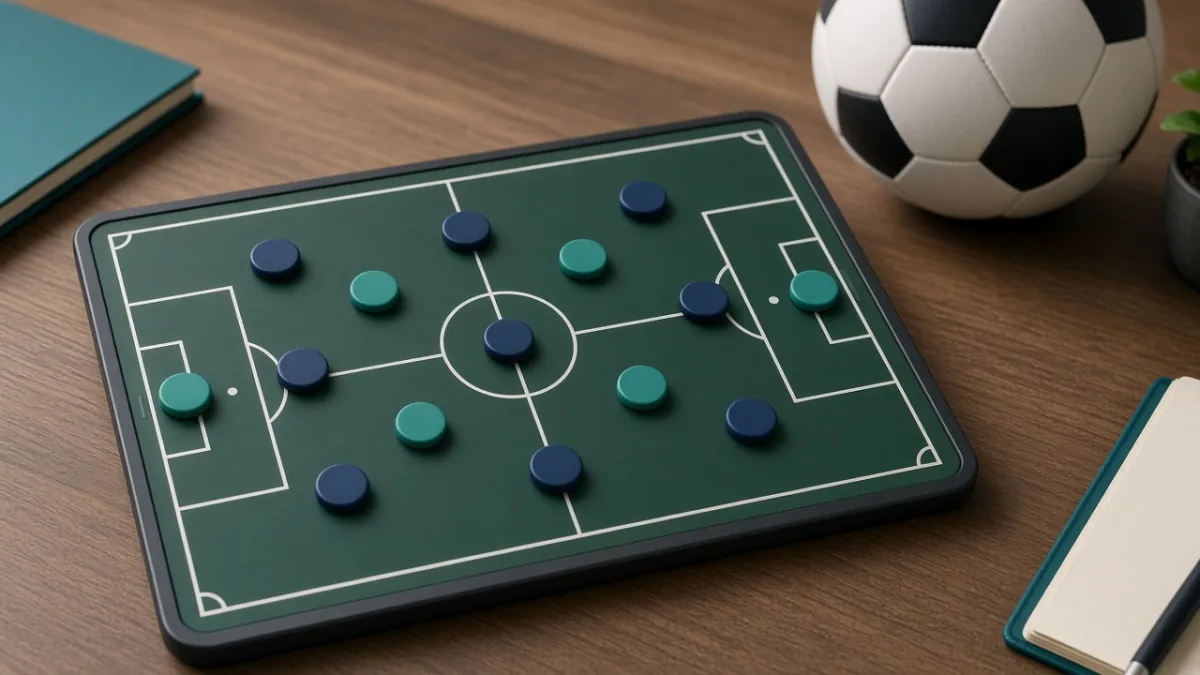
Formation numbers always list outfield players from defense to attack (the goalkeeper is never included in the numbers). Remember that formations are only starting shapes—teams constantly shift shape depending on whether they have the ball:
What Each Position Group Does With and Without the Ball
| Position Line | In Possession (When Attacking) | Out of Possession (When Defending) |
|---|---|---|
| Goalkeeper (GK) | Acts as an extra passing outlet behind the defense and launches quick counters | Protects the goal frame, commands the penalty box on crosses, and sweeps behind high lines |
| Centre-Backs (CB) | Split wide to circulate the ball, progress passes into midfield, and guard against counterattacks | Hold a synchronized offside line, track strikers, block shots, and clear crosses |
| Fullbacks & Wing-Backs (LB/RB/WB) | Provide width along the touchline, overlap wingers, or step inside to create midfield overloads | Shut down opposition wingers, block crosses, and tuck inside to cover the far post |
| Central & Defensive Midfielders (CDM/CM) | Receive under pressure, switch play from side to side, and carry the ball forward | Screen passes into opposition forwards, counter-press immediately after losing the ball, and win second balls |
| Attacking Midfielders & Wingers (CAM/LW/RW) | Dribble 1v1, play through-balls, deliver crosses, and attack the penalty box | Press opposition fullbacks/CDMs, block passing lanes, and track back to double-team wide threats |
| Strikers (ST/CF/SS) | Pin centre-backs, make runs in behind, hold up long passes, and finish scoring chances | Initiate the team's first line of press and force opposition defenders toward one side |
How to Choose Your Best Football Position (Or Watch a Match Like a Tactician)
- Enjoy shot-stopping, vocal leadership, and 1v1 bravery? Train at Goalkeeper (GK), where positioning and calm footwork matter as much as diving saves.
- Love reading danger early, winning duels, and organizing teammates? Try Centre-Back (CB) if you are strong in the air and calm on the ball, or Fullback (LB/RB) if you have high sprint stamina for wide 1v1 battles.
- Want to touch the ball constantly and connect every phase of play? Choose Defensive Midfield (CDM) if you excel at intercepting passes and keeping possession safe, or Central Midfield (CM) if you have the engine to run box-to-box.
- Thrive on creativity, tight spaces, or 1v1 dribbling? Play Attacking Midfielder (CAM) to thread final passes through the middle, or Winger (LW/RW) to isolate defenders out wide and cut inside to shoot.
- Have an instinct for goal and sharp movement inside the penalty box? Play Striker (ST/CF), focusing on timing your runs across the front post and pressing defenders when your team loses the ball.
- When watching live matches, track one player for 3 minutes instead of only watching the ball: Watch where a CDM looks before receiving a pass (scanning) or how a 4-3-3 team morphs into a 4-5-1 shape as soon as the opponent wins possession.
Frequently Asked Questions
How many positions are there in football?
An 11-player football team is divided into 4 main groups—Goalkeeper, Defenders, Midfielders, and Forwards—which break down into 10 standard tactical roles (GK, CB, LB/RB, LWB/RWB, CDM, CM, CAM, LW/RW, SS, and ST/CF).
What is the most important position in football?
No single position wins matches alone, though central spine roles—Goalkeeper (GK), Centre-Back (CB), Defensive Midfielder (CDM), and Striker (ST)—often have the most direct impact on preventing and scoring goals.
What is the difference between a CDM, CM, and CAM?
A CDM (Defensive Midfielder, or #6) stays deeper to shield the defense and win the ball back; a CM (Central Midfielder, or #8) links defense and attack from box to box; and a CAM (Attacking Midfielder, or #10) operates higher up between the opponent's midfield and defense to create goalscoring chances.
What is the difference between a fullback (LB/RB) and a wing-back (LWB/RWB)?
A fullback plays on the left or right of a four-player defense (such as 4-3-3) with a winger ahead of them. A wing-back plays in a three-centre-back system (such as 3-5-2) and is responsible for patrolling the entire flank in both attack and defense.
What does 4-3-3 mean in football?
Formation numbers list outfield players from back to front, excluding the goalkeeper: 4-3-3 means 4 defenders (LB, two CBs, RB), 3 midfielders, and 3 forwards (LW, ST, RW).
What is the difference between a striker and a forward?
"Forward" is the broad category for all attacking players (including wingers, second strikers, and centre-forwards), whereas "striker" (ST) specifically refers to the central player positioned closest to the opponent's goal whose primary job is finishing chances.
Sources
Tags: Sports GuidesHow-ToStep-by-Step