
Carry-On Liquids Rules Explained: 100 ml Limit, Clear Bag & Airport Exceptions
Carry-on liquids rules determine which drinks, toiletries, gels, pastes, and aerosols can pass through airport security in your cabin bag. While the standard 100 ml (3.4 oz) container limit inside a single 1-liter transparent resealable bag remains the safest baseline worldwide, scanner upgrades mean rules can differ between your departure, transfer, and return airports—so packing to the strictest checkpoint on your itinerary prevents surprises at security.
On this page4
What Counts as a Liquid in Hand Luggage? (Drinks, Gels, Pastes & Foods)
At airport security checkpoints, "liquids" (often called LAGs: Liquids, Aerosols, and Gels) include far more than beverages. Any spreadable, squeezable, or sprayable item is typically screened under liquid rules:
| Item Category | Examples | Carry-On Packing Rule | Smart Travel Tip |
|---|---|---|---|
| Drinks & Beverages | Water, juice, coffee, soup, yogurt drinks | Must be emptied or consumed before security (unless 100 ml or less in your clear bag) | Bring an empty reusable bottle and refill it after passing the checkpoint |
| Toiletries & Perfumes | Shampoo, conditioner, body lotion, sunscreen, liquid foundation, perfume | Each container must be 100 ml (3.4 oz) or less and fit comfortably in the 1L clear bag | Decant into labeled 50–100 ml silicone travel bottles or pack full-size bottles in checked luggage |
| Gels, Pastes & Makeup | Toothpaste, hair gel, lip gloss, liquid eyeliner, mascara, cream concealer | Treated as liquids/gels and must go inside the clear resealable bag | Use a travel-size toothpaste tube rather than a half-used family tube |
| Aerosols & Sprays | Spray deodorant, hairspray, shaving foam, facial mist | Must be 100 ml or less in cabin baggage and comply with airline dangerous-goods limits | Switch to a solid deodorant stick to save space inside your clear liquids bag |
| Semi-Liquid Foods | Honey, jam, peanut butter, hummus, soft cheese, sauces, salsas | Count as liquids/gels at security; jars over 100 ml will be refused in cabin bags | Pack food jars in checked baggage wrapped in sealed plastic bags |
| Medicines & Baby Supplies | Prescription syrups, insulin, contact-lens solution, baby milk/formula, purees | Exempt from the 100 ml limit in reasonable flight quantities when declared for inspection | Keep in a separate pouch at the top of your bag with prescriptions or pharmacy labels |
| Solid Alternatives | Bar soap, solid shampoo/conditioner bars, stick deodorant, powder makeup, lip balm sticks | Not subject to the 100 ml liquid bag limit at most checkpoints | Keep solids easily accessible in case a scanner flags dense items for a quick visual check |
Why Carry-On Liquid Rules Differ Between Airports (And Why 100 ml Is Still Safest)
Although some terminals have installed 3D Computed Tomography (CT) cabin baggage scanners that let passengers leave liquids inside their bags, many airports—and even specific terminals within the same airport—still enforce the traditional 100 ml (3.4 oz) and 1-liter clear bag rule. Even if your departure airport allows larger containers, your connecting airport or return flight airport may strictly enforce the 100 ml limit and confiscate oversized bottles.
Unless you have verified on the official website of every single airport on your outbound, connecting, and return itinerary that larger containers are accepted, always pack to the classic 100 ml / 1-liter clear bag standard.
Exceptions: Liquid Medicine, Baby Milk, and Duty-Free Purchases
How to Pack Carry-On Liquids Step by Step (6-Step Checklist)
- Check the printed volume on every bottle: Ensure every container says 100 ml (3.4 oz) or less—a 150 ml bottle with only a few drops left will still be rejected.
- Transfer larger products or switch to solids: Decant lotions and shampoos into 50–100 ml travel bottles, or swap to solid shampoo bars and stick deodorant.
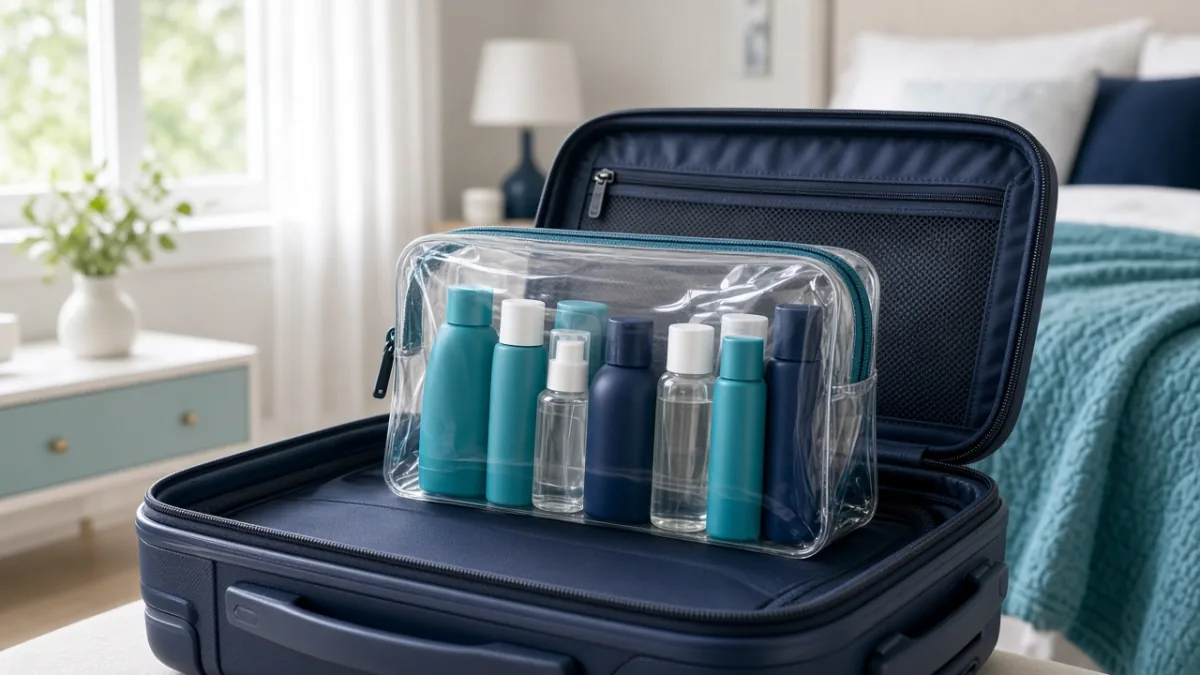
- Use one transparent, resealable 1-liter bag: Use a clear zip-top bag (roughly 20 cm × 20 cm / quart-sized) and make sure the zipper closes completely flat without bulging.
- Separate exemptions into their own pouch: Place liquid medications, contact solution, or baby milk in a separate accessible bag so they do not crowd your 1-liter toiletry bag.
- Do a hidden-liquids pocket sweep before leaving home: Check coat pockets, makeup pouches, and backpack side pockets for forgotten lip gloss, hand sanitizer, toothpaste, food jars, or half-full water bottles.
- Pack the clear bag at the very top of your carry-on: Keep your liquids bag right under the top zipper so you can pull it out into the security tray in two seconds if requested.
Frequently Asked Questions
Can I bring liquids in my carry-on bag?
Yes. At most airports worldwide, you can bring liquids, aerosols, gels, creams, and pastes in your carry-on bag provided each individual container holds 100 ml (3.4 oz) or less and all containers fit comfortably inside one transparent, resealable 1-liter (quart-sized) plastic bag.
Does the 100 ml liquid rule apply to every airport?
While a few airports with new 3D CT scanners have relaxed rules for specific lanes, the 100 ml rule still applies at the vast majority of global checkpoints. Because your transfer or return airport may enforce the 100 ml limit even if your departure airport does not, packing to the 100 ml standard is the safest approach.
Can I bring a half-full 200 ml bottle in my hand luggage?
No. Airport security officers judge compliance by the printed capacity of the container itself, not by how much product remains inside. Transfer the remaining liquid into a travel bottle marked 100 ml or smaller, or pack the larger bottle in checked luggage.
Can I take an empty water bottle through airport security?
Yes. An empty reusable water bottle (plastic, stainless steel, or insulated) can pass through security at almost all airports as long as there is zero liquid or ice inside during screening. You can refill it at water stations once you are past security.
Are liquid medicines and baby milk exempt from the 100 ml rule?
Yes. Essential liquid medications, medical cooling gel packs, and baby milk, formula, or baby food needed for the flight are permitted in quantities over 100 ml. Keep them separate from your standard toiletries, bring prescription labels if applicable, and declare them to security staff for separate screening.
Can I take duty-free liquids on a connecting flight?
Usually yes, provided the duty-free shop places the liquid and the itemized receipt inside an official sealed Security Tamper-Evident Bag (STEB) and you do not open or unseal the bag until you reach your final destination. Always confirm transfer rules if your connection requires exiting landside and re-entering security.
Sources
- UK Government (GOV.UK) — Hand luggage restrictions at UK airports: Liquids
- U.S. Transportation Security Administration (TSA) — Liquids, Aerosols, and Gels Rule (3-1-1)
- UK Government (GOV.UK) — Hand luggage restrictions: Essential medicines and medical equipment
- International Air Transport Association (IATA) — Travelers’ Baggage Guidance
Tags: Travel GuidesPacking TipsHow-ToStep-by-Step