



How VAR Works in Football: A Beginner’s Guide
VAR is a video-review system that helps the on-field referee check a small group of important match decisions. It does not referee the whole game or correct every possible mistake. Understanding what it can review, who makes the final decision, and when the system can intervene makes the process much easier to follow.
On this page19
- What is VAR in football?
- What can VAR review?
- Who is involved in a VAR review?
- How does the VAR review process work?
- How a VAR review works in 5 steps
- How does VAR offside work?
- Why is VAR not perfect?
- What are common VAR misunderstandings?
- How should you watch a VAR decision as a beginner?
- Quick recap: what should you remember about VAR?
- FAQ: How VAR works
- What does VAR stand for in football?
- What decisions can VAR check?
- Can VAR overturn the referee?
- Does every VAR check lead to an on-field review?
- Can VAR review an offside decision?
- Can VAR review a yellow card?
- Why does the referee sometimes watch the screen?
- Is VAR used in every football competition?
What is VAR in football?
VAR is a match-official support system that uses video replays to help the referee when a potentially important decision may contain a clear and obvious error or a serious missed incident. The video assistant referee works with the on-field referee; the video official does not take over the match.
The letters stand for Video Assistant Referee. In everyday conversation, people often use “VAR” to mean both the official and the wider video-review process. More precisely, the VAR is the trained match official who has access to replay footage and communicates relevant information to the referee.
VAR is used only in competitions that have introduced and approved the system. It is not automatically present in every football match. The equipment, staffing, communication arrangements, and exact competition procedures can differ.
The central idea is support, not replacement. The referee must make an initial decision as the incident happens. VAR can check whether that decision should be reviewed, but the referee remains responsible for the final outcome. That distinction explains why a referee may listen to the VAR and keep the original decision, or review a screen and then change it.
What can VAR review?
VAR is limited to defined match-changing categories. The core areas are goal or no-goal decisions, penalty or no-penalty decisions, red-card incidents, and mistaken identity; the current Laws also provide a competition-option review for a clearly incorrect corner decision when it can be corrected immediately without delaying the restart.
| VAR may review | What the review can involve | Generally outside the review scope |
|---|---|---|
| Goal / no goal | Whether the ball crossed the line; a possible attacking foul or handball; offside in the attacking phase; whether the ball went out before the goal; relevant penalty-kick offences | An unrelated foul earlier in the match |
| Penalty / no penalty | Whether an offence occurred; whether it happened inside or outside the penalty area; a missed or wrongly awarded penalty; relevant attacking offences before the incident | Ordinary fouls elsewhere that are not connected to a reviewable incident |
| Red-card incidents | Serious foul play, violent conduct, certain serious offences, and a clearly incorrect second caution that results in a red card | A routine yellow card, or a potential second-yellow offence that the referee did not punish with a second caution |
| Mistaken identity | Whether the referee cautioned or sent off the wrong player | Reconsidering the underlying foul unless it belongs to another reviewable category |
| Clearly incorrect corner (competition option) | A corner decision that is clearly wrong and can be corrected immediately before the restart | A corner, throw-in, or other restart after play has restarted |
The important phrase is reviewable incident. A replay does not give VAR permission to revisit anything that happened on the pitch. For example, a normal free-kick decision is not automatically reviewable just because a broadcast later shows another camera angle.
The rules also distinguish between the ordinary review categories and the optional corner-kick provision. A competition must choose whether to use that option, and the correction has to happen immediately without delaying the restart. Always check the current rules of the competition you are watching.
Who is involved in a VAR review?
The main referee controls the match and makes the final decision. The VAR and supporting video officials review available footage, communicate relevant information, and help the referee decide whether a formal review is appropriate.
| Person or location | Main role | What beginners should remember |
|---|---|---|
| On-field referee | Makes the original decision, decides whether to review, and announces the final decision | VAR does not overrule the referee independently |
| Video Assistant Referee (VAR) | Watches replays, checks reviewable incidents, and recommends a review when the protocol threshold may be met | The VAR advises; the referee decides |
| Assistant VAR (AVAR) | Supports the VAR, monitors footage or communication, and helps manage the review process | More than one supporting official may be used |
| Video operation room | The area where video officials watch and control available broadcast footage | It is separate from the referee’s review monitor at the pitch |
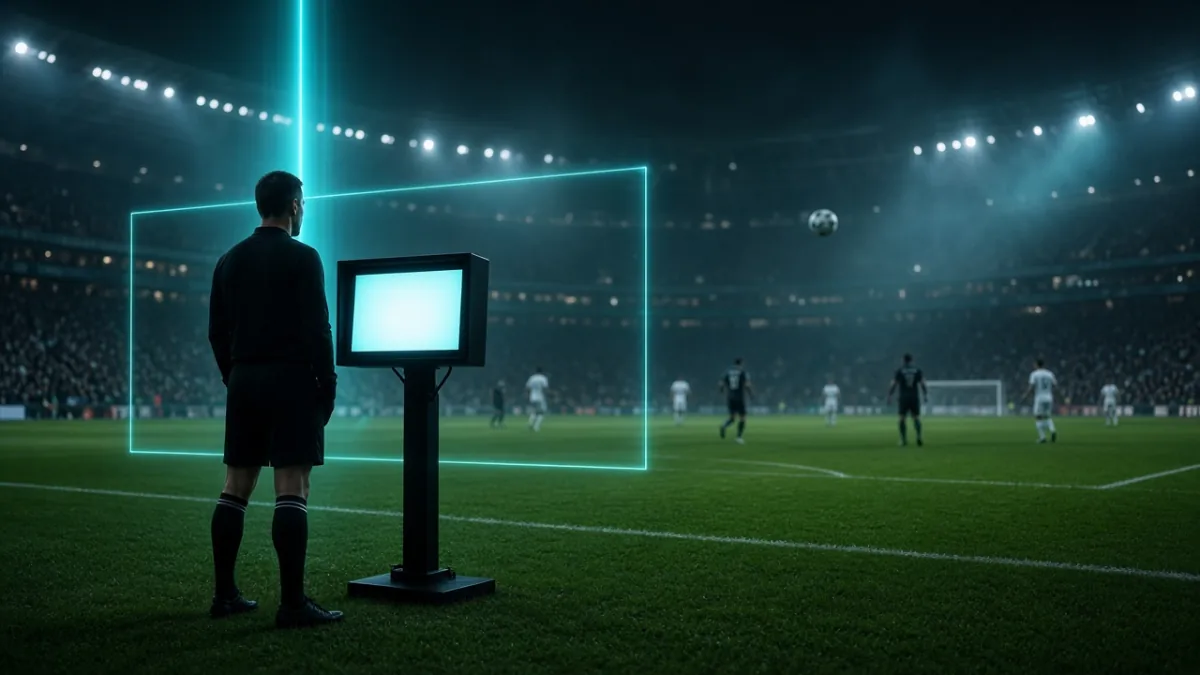
| Referee review area | The pitch-side screen area used for an on-field review | The referee goes there when viewing the incident directly is appropriate |
The precise team can include additional video officials and replay operators, depending on the match and the competition’s arrangements. Their job is to help the referee assess the available evidence, not to vote on a decision.
Players and coaches do not get to order a review. They may express disagreement, but the protocol does not give them the power to demand that the referee checks the screen. The referee is the only person who initiates the formal review.
How does the VAR review process work?
A VAR review follows a sequence: the referee makes an initial decision, the video team checks the relevant footage, a possible serious error is communicated, the referee decides whether to review, and the referee gives the final decision.
How a VAR review works in 5 steps
- The referee makes an initial decision. The match is officiated normally; the referee does not wait for video before making every call.
- The VAR checks the incident. The video team looks at relevant angles and replay speeds for a situation within the review rules.
- The VAR communicates if there may be a serious error. If the footage does not suggest a reviewable error, the check may remain silent and play continues.
- The referee decides whether to review. The referee may accept information from the VAR or go to the pitch-side monitor for an on-field review.
- The referee announces the final decision. The referee uses the review signal and communicates the outcome before play restarts.
A check and a review are not the same thing. A check is the video team’s assessment of a potentially reviewable incident. Many checks do not lead to a screen visit or a visible change because the original decision is not clearly wrong.
A formal on-field review is more likely when the decision involves judgement, such as the intensity of a challenge, the nature of handball, or whether a player interfered with an opponent. For factual questions—such as a player’s position, the location of contact, or whether the ball went out—a VAR-only review may be enough. The match protocol determines the appropriate process.
How does VAR offside work?
VAR can check an offside decision when it is connected to a reviewable goal or penalty incident. The video team examines the relevant moment and the positions of the players, while the referee remains responsible for the final decision.
Offside decisions can involve both facts and interpretation. The factual part includes where the relevant attacking player and the ball were when a teammate played the ball. The judgement part includes whether a player in an offside position became involved in active play—for example, by interfering with an opponent or gaining an advantage.
For a goal review, officials may need to examine the attacking phase that led directly to the goal. That can include an earlier offside, foul, or handball by the attacking team. It does not mean every earlier event in the match can be reopened.
Some competitions use additional technology to help identify offside positions. The tools and presentation can vary, and a graphic shown on television is an explanation of the decision rather than the decision-maker itself. The referee remains responsible for the outcome under the protocol.
Why is VAR not perfect?
VAR improves the information available to match officials, but it cannot make every football decision automatic. Some incidents are factual; others require interpretation of the Laws of the Game, and camera footage may not show every detail clearly.
First, the system has a limited scope. A disputed ordinary foul may be outside the review categories even if supporters believe it was important. Second, a review normally requires a clear and obvious error or a serious missed incident. VAR is not intended to re-referee a decision simply because another interpretation is possible.
Third, camera angles and replay quality matter. A view may be blocked, distant, or unavailable at the exact moment. Different angles can clarify an incident, but they can also leave uncertainty about contact, intent, or a player’s view of the play.
Finally, the Laws contain judgement-based concepts. The speed of a challenge, the effect of a player’s action, and whether an opponent was affected may not be settled by drawing a line or freezing a frame. Slow motion is useful for factual details, while normal speed is important for judging the intensity of an action.
VAR is therefore best understood as a way to correct certain important and clearly identifiable mistakes—not a promise that every decision will be universally agreed.
What are common VAR misunderstandings?
Most confusion comes from expecting VAR to review every incident or assuming that the video official has the final authority. The system is narrower and more structured than many viewers expect.
| Common misunderstanding | What actually happens |
|---|---|
| “VAR checks every foul.” | VAR checks only incidents within the defined review categories and threshold. An ordinary foul is not automatically reviewed. |
| “The VAR makes the final decision.” | The referee on the pitch makes the final decision, with or without an on-field review. |
| “Every check means the referee must visit the screen.” | A check may be completed silently. A screen review is used when the procedure and type of decision call for it. |
| “Slow motion always tells the whole story.” | Slow motion helps with factual details, but normal speed is important for judging intensity and context. |
| “A team can demand a review.” | Players and coaches cannot initiate a formal review; only the referee can do so. |
| “VAR can correct any restart.” | Restart decisions generally cannot be changed after play has restarted. A narrow competition-option exception applies to a clearly incorrect corner if corrected immediately. |
It also helps to separate the broadcast experience from the official process. Television viewers may see many replays, graphics, and pundit opinions. The match officials use the footage and protocol available to them, and the final decision is not a public poll.
How should you watch a VAR decision as a beginner?
The easiest way to understand a review is to ask three questions: what kind of incident is it, what was the referee’s original decision, and did the referee change it after receiving video information? This keeps the process clear without needing to know every technical detail.
When the referee touches the earpiece or delays a restart, a check may be taking place. If the referee makes the TV-shaped signal and walks to the pitch-side monitor, the referee is undertaking an on-field review. If there is no monitor visit, the final decision may have been made after a VAR-only review or the check may have found no reason to intervene.
Try following the sequence rather than judging the outcome from the first replay. Notice whether the incident relates to a goal, penalty, red card, mistaken identity, or the optional corner provision. Then listen for the referee’s final signal and watch how play restarts.
Quick recap: what should you remember about VAR?
VAR is a support system for the referee, not a second referee with unlimited authority. It focuses on a defined set of important incidents and only changes the original decision when the protocol threshold is met.
The referee on the pitch always owns the final decision. A check can finish without a screen visit, and the type of incident affects whether a VAR-only review or an on-field review is appropriate. A clearly incorrect second caution that results in a red card is included in the current red-card review category, while an incorrectly awarded corner may be reviewable only if the competition uses that option and the decision can be corrected immediately.
The exact implementation can differ between competitions, and football’s governing body can update the protocol. If a detail matters, consult the current official Laws of the Game and the competition’s rules rather than assuming every tournament follows an identical setup.
Further reading: official football laws and protocols; competition-specific regulations; governing-body referee education resources.
FAQ: How VAR works
What does VAR stand for in football?
VAR stands for Video Assistant Referee. It refers to the match official who uses replay footage to assist the referee with certain important decisions; people also use “VAR” as shorthand for the video-review process.
What decisions can VAR check?
VAR can review defined incidents involving goals, penalties, red cards, and mistaken identity. The current protocol also allows a competition to review a clearly incorrect corner decision if it can be corrected immediately without delaying the restart.
Can VAR overturn the referee?
The VAR cannot independently replace the referee’s decision. The video official can provide information or recommend a review, but the referee on the pitch makes and communicates the final decision.
Does every VAR check lead to an on-field review?
No. Many checks finish without the referee visiting the pitch-side monitor. If the footage does not show a clear and obvious error or serious missed incident, the original decision usually stands.
Can VAR review an offside decision?
Yes, when offside is connected to a reviewable incident such as a goal or relevant penalty decision. The video team checks player positions and involvement, while the referee remains responsible for the final outcome.
Can VAR review a yellow card?
A routine yellow card is generally outside the review categories. Under the current protocol, a clearly incorrect second caution that results in a red card can be reviewed; a missed potential second-yellow offence is not the same situation.
Why does the referee sometimes watch the screen?
The referee may conduct an on-field review when seeing the footage directly is appropriate, especially for decisions involving judgement. For more factual matters, the referee may make the final decision using information supplied by the VAR without visiting the screen.
Is VAR used in every football competition?
No. VAR is used only in competitions that have adopted and received approval to use the system. The available technology and optional review provisions can differ, so check the rules of the competition you are watching.
Frequently Asked Questions
What does VAR stand for in football?
VAR stands for Video Assistant Referee. It refers to the match official who uses replay footage to assist the referee with certain important decisions; people also use “VAR” as shorthand for the video-review process.
What decisions can VAR check?
VAR can review defined incidents involving goals, penalties, red cards, and mistaken identity. The current protocol also allows a competition to review a clearly incorrect corner decision if it can be corrected immediately without delaying the restart.
Can VAR overturn the referee?
The VAR cannot independently replace the referee’s decision. The video official can provide information or recommend a review, but the referee on the pitch makes and communicates the final decision.
Does every VAR check lead to an on-field review?
No. Many checks finish without the referee visiting the pitch-side monitor. If the footage does not show a clear and obvious error or serious missed incident, the original decision usually stands.
Can VAR review an offside decision?
Yes, when offside is connected to a reviewable incident such as a goal or relevant penalty decision. The video team checks player positions and involvement, while the referee remains responsible for the final outcome.
Can VAR review a yellow card?
A routine yellow card is generally outside the review categories. Under the current protocol, a clearly incorrect second caution that results in a red card can be reviewed; a missed potential second-yellow offence is not the same situation.
Why does the referee sometimes watch the screen?
The referee may conduct an on-field review when seeing the footage directly is appropriate, especially for decisions involving judgement. For more factual matters, the referee may make the final decision using information supplied by the VAR without visiting the screen.
Is VAR used in every football competition?
No. VAR is used only in competitions that have adopted and received approval to use the system. The available technology and optional review provisions can differ, so check the rules of the competition you are watching.
Sources
Tags: Sports GuidesHow-ToStep-by-Step